... THE MATHEMATICAL ELECTRON ...
a Programmer-God Simulation-Hypothesis model
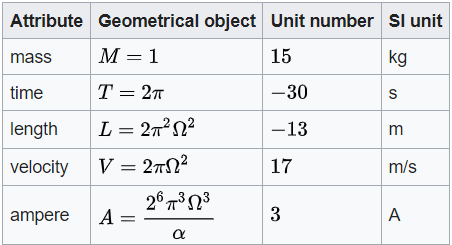
if we assign geometrical objects to mass, space and time at the Planck scale,
and then link them via this unit number relationship,
we can build a physical universe from pure mathematical structures.
Could a Programmer God have used this approach?
The Programmer God
The question as to whether our entire universe is a Matrix-style simulation is, like God, considered to be a philosophical debate, for it is presumed that it cannot be proved (or disproved). However there are anomalies in the physical constants (G, h, c, e ...) that constitute evidence we are in a simulation (these anomalies cannot be explained by a purely physical universe). Furthermore they suggest coding and this implies a Programmer. From these anomalies we can reverse engineer parts of the Programmer's source code. This text is a discussion of that source code.
Caveat. Readers should note that any candidate for a Programmer-God simulation-universe source code must satisfy these conditions;
1. It can generate physical structures (mass, space, time) from mathematical forms.
2. The sum universe is dimensionless (simply data on a celestial hard disk).
3. We must be able to use it to derive the laws of physics (because the source code is the origin of the laws of nature, and the laws of physics are our observations of the laws of nature).
4. The mathematical logic must be unknown to us (the Programmer is a non-human intelligence).
5. The coding should have an 'elegance' commensurate with the Programmer's celestial level of skill.
This model—built around a mathematical electron formula—proposes that all of these constraints can be resolved using those geometrical objects alone (see table above). The only physical constant used consistently by this model is the dimensionless fine-structure constant
alpha, the rest can be generated internally (within the simulation itself).
Simulation Hypothesis
The Simulation Hypothesis posits that our reality is an artificial reality, such as generated in a computer simulation. The idea was popularized in the 1999 sci-fi film 'The Matrix'.
The ancestor simulation proposes that an advanced civilization could simulate our universe to the degree that we can observe (as with VR helmets today). This version however presumes a base reality, the physical planet of the original programmers. Conversely, a deep-universe (Programmer God) simulation begins with the big bang and constructs the universe in its entirety, including lifeforms, and down to the smallest detail (see Planck scale).
The science vs. God debate exists primarily because God (the 'external' hand) does not appear in the formulas of physics, and so as God has no measurable parameters, God is an untestable hypothesis. Thus the fundamental constraint to any God-did-it model: - our understanding of the universe is interpreted through the lens of ‘physics’, and while the formulas of physics use numbers such as; the speed of light, electron mass, gravity ... there are no formulas that require an external 'hand' (there is no 'E = God.c2' formula, for example), and so science has no need or use for a God. Consequently, any model based on a 'God-did-it' axiom must be able to offer a method by which this God could have set the laws of physics in motion.
This is the subject of this website, the objective is to demonstrate that our universe can be reconstructed with geometrical tools that the Gods could have used. The laws-of-physics would then become our observations of this deeper world.
Planck scale:
Physics is principally divided into studies of the quantum world and the macro world (of planets and stars). These are separated by 2 successful yet incompatible theories; quantum mechanics and relativity. However there is a deeper world, a theoretical world that is far below the quantum world, and this is called the Planck world. The quantum scale is to the Planck scale as our world is to the quantum scale. It is suggested here that the laws of nature operate at this Planck level, and that at this level we may find evidence of that external intelligence, for at this level the universe is a mathematical universe. And so, if we want to understand the quantum world, we must first begin with this Planck world.
Note: the mathematics (physics) of this model has been moved to this website
simulationuniverse.org
PLANCK SCALE
The universe OS (operating system) runs at the Planck scale. At this scale the universe is discrete and mathematical. When we add the dimension of time (frequency) we reach the the quantum scale. At this scale physical forms emerge (whilst the electron is a mathematical particle, its parameters are physical). The macro scale is a statistical summing and averaging (over time) of the quantum scale. At the macro scale the universe is physical. See tab "digital physics".
MTP -- PROBLEM #1
The fundamental problem for any Programmer God is creating actual physical dimensions (of mass, space and time), from mathematical structures. Here I introduce a geometrical artifice that the Programmer could have used. It supposes (requires) a relationship between mass, space and time (these are not independent attributes). See tab "MTP".