... THE MATHEMATICAL ELECTRON ...
a Programmer-God Simulation-Hypothesis model
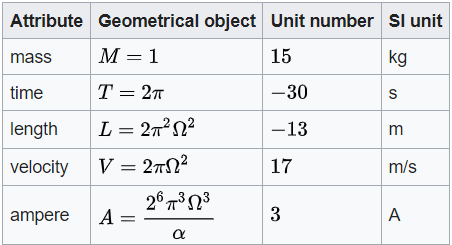
if we assign geometrical objects to mass, space and time at the Planck scale,
and then link them via this unit number relationship,
we can build a physical universe from pure mathematical structures.
Could a Programmer God have used this approach?
This model began as a series of notes on the philosophy of destiny, the premise being that if there is a discernible pattern to human events, i.e.: that a ‘chance meeting’ has occurred, not by ‘chance’, but according to or influenced by an unseen set of rules, then this same set of rules may also apply to the universe itself, that our universe is not the result of random events but may follow, or even be guided by, a definite set of principles.
If there were such principles, then we could surmise that they would complement of the ‘Laws of Physics’, and so it might be possible to mathematically codify a theory of 'destiny' in the same sense that we can code the laws of gravity, or any other physical law.
With no preconceptions as to what such a theory might look like, or even if there might be such a theory, in 2003 I began writing a series of notes as ideas came. The square root of momentum appeared as a primary constant and so by December I had enough material to compile into a booklet ‘The Chess Board Universe’. Unknowingly the model, and my sojurn to solve it, had begun.
I have continued working on the theory since, although I took many wrong turns (for the most part I was working in the fog, not knowing where all this was leading), nevertheless I never hit a wall, a solution would eventually appear, and this kept me going.
The final addition is the geometry of the Heavens, a work still in progress.
This theory appeared over the years by a natural selection of ideas, those chapters that reinforced each other grew together; those chapters that remained alone were eventually deleted. Curiously this approach parallels the theory itself, that to solve a 'biological' problem (being the workings of nature itself), I needed a biological computer, we all have one, its called the brain ... and so the question became how to use it to solve this problem. My solution was to change my environment whenever I 'got stuck', and so I have typed my way across the planet over the last 20 years, armed with a laptop and a backpack.