... THE MATHEMATICAL ELECTRON ...
a Programmer-God Simulation-Hypothesis model
if we assign geometrical objects to mass, space and time at the Planck scale,
and then link them via this unit number relationship,
we can build a physical universe from pure mathematical structures.
Could a Programmer God have used this approach?
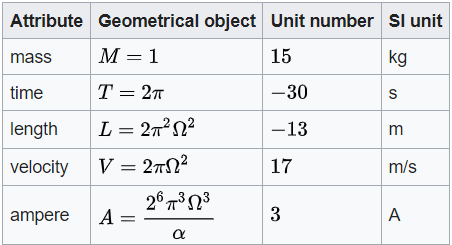
General notes on the physical constants
In the “Trialogue on the number of fundamental physical constants” was debated the number of fundamental dimension units required, noting that "There are two kinds of fundamental constants of Nature: dimensionless alpha and dimensionful (c, h, G). To clarify the discussion I suggest to refer to the former as fundamental parameters and the latter as fundamental (or basic) units. It is necessary and sufficient to have three basic units in order to reproduce in an experimentally meaningful way the dimensions of all physical quantities. Theoretical equations describing the physical world deal with dimensionless quantities and their solutions depend on dimensionless fundamental parameters. But experiments, from which these theories are extracted and by which they could be tested, involve measurements, i.e. comparisons with standard dimensionful scales. Without standard dimensionful units and hence without certain conventions physics is unthinkable".
-Michael J. Duff et al JHEP03(2002)023.
At present, there is no candidate theory of everything that is able to calculate the mass of the electron.
-https://en.wikipedia.org/wiki/Theory-of-everything (02/2016)
Planck units (m_P, l_p, t_p, ampere A_p, T_P) are a set of natural units of measurement defined exclusively in terms of five universal physical constants, in such a manner that these five constants take on the numerical value of G = hbar = c = 1/4pi epsilon_0 = k_B = 1 when expressed in terms of these units. These units are also known as natural units because the origin of their definition comes only from properties of nature and not from any human construct. Max Planck wrote of these units; "we get the possibility to establish units for length, mass, time and temperature which, being independent of specific bodies or substances, retain their meaning for all times and all cultures, even non-terrestrial and non-human ones and could therefore serve as natural units of measurements...".
-Uber irreversible Strahlungsforgange. Ann. d. Phys. (4), (1900) 1, S. 69-122
In 1963, Dirac noted regarding the fundamental constants; "The physics of the future, of course, cannot have the three quantities hbar, e, c all as fundamental quantities, {only two of them can be fundamental, and the third must be derived from those two}."
-Dirac, Paul; The Evolution of the Physicist's Picture of Nature, June 25, 2010
In the article "Surprises in numerical expressions of physical constants", Amir et al write ... In science, as in life, `surprises' can be adequately appreciated only in the presence of a null model, what we expect a priori. In physics, theories sometimes express the values of dimensionless physical constants as combinations of mathematical constants like pi or e. The inverse problem also arises, whereby the measured value of a physical constant admits a `surprisingly' simple approximation in terms of well-known mathematical constants. Can we estimate the probability for this to be a mere coincidence?
-Ariel Amir, Mikhail Lemeshko, Tadashi Tokieda; 26/02/2016, {Surprises in numerical expressions of physical constants}
arXiv:1603.00299 [physics.pop-ph]
"The fundamental constants divide into two categories, units independent and units dependent, because only the constants in the former category have values that are not determined by the human convention of units and so are true fundamental constants in the sense that they are inherent properties of our universe. In comparison, constants in the latter category are not fundamental constants in the sense that their particular values are determined by the human convention of units".
-Leonardo Hsu, Jong-Ping Hsu;
{The physical basis of natural units}; Eur. Phys. J. Plus (2012) 127:11
A charged rotating black hole is a black hole that possesses angular momentum and charge. In particular, it rotates about one of its axes of symmetry. In physics, there is a speculative notion that if there were a black hole with the same mass and charge as an electron, it would share many of the properties of the electron including the magnetic moment and Compton wavelength. This idea is substantiated within a series of papers published by Albert Einstein between 1927 and 1949. In them, he showed that if elementary particles were treated as singularities in spacetime, it was unnecessary to postulate geodesic motion as part of general relativity.
-Burinskii, A. (2005). {"The Dirac–Kerr electron"}. arXiv:hep-th/0507109
The Dirac Kerr–Newman black-hole electron was introduced by Burinskii using geometrical arguments. The Dirac wave function plays the role of an order parameter that signals a broken symmetry and the electron acquires an extended space-time structure. Although speculative, this idea was corroborated by a detailed analysis and calculation.
Mathematical Platonism is a metaphysical view that there are abstract mathematical objects whose existence is independent of us.
-Linnebo, Øystein, {"Platonism in the Philosophy of Mathematics"}, The Stanford Encyclopedia of Philosophy (Summer 2017 Edition), Edward N. Zalta (ed.), plato.stanford.edu/archives/sum2017/entries/platonism-mathematics
Mathematical realism holds that mathematical entities exist independently of the human mind. Thus humans do not invent mathematics, but rather discover it. Triangles, for example, are real entities, not the creations of the human mind.
-https://en.wikipedia.org/wiki/Philosophy-of-mathematics (22, Oct 2017).