N-Body Orbital Simulation
the Programmer-God Simulation-Hypothesis model
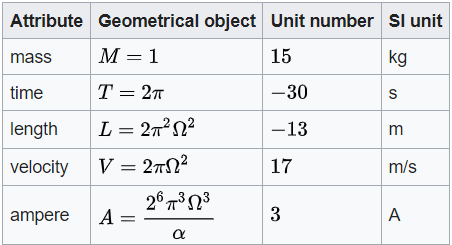
if we assign geometrical objects to mass, space and time at the Planck scale,
and then link them via this unit number relationship,
we can build a physical universe from pure mathematical structures.
Could a Programmer God have used this approach?
n-body orbits
The simulation assigns points to represent units of Planck mass rotating around each other (see wave-point oscillation). To do actual analysis of the orbits we can clump a set of orbits in near vicnity (the orbited mass) and assign 1 point at a distance, the orbiting mass. For example we could do a simple earth-moon orbit by setting 81 points nearby and 1 point at distance given that the earth moon mass ratio is 81:1. This would then be considered as a 2-body orbit although the simulation itself is still rotating all points around each other.
The program (Gravitational-orbital-simulation-2body.c) simulates a 2-body orbit. The calculated period and length of orbit are then compared with the simulation data to confirm that the calculation formulas do accurately represent the orbital data. Once this is established, these formulas can then be applied to simulating real world orbits. The earth-moon orbit is an example, as well as the Kepler derivation of G. Setting variable kr = 32 (a discrete mass-length ratio that quantises the orbital radius in terms of the central mass Schwarzschild radius) is probably the maximum radius for long double precision in C.
wiki- gravitational and atomic orbitals