... THE MATHEMATICAL ELECTRON ...
a Programmer-God Simulation-Hypothesis model
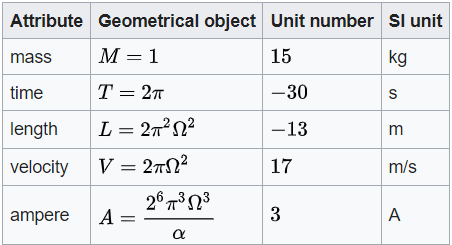
if we assign geometrical objects to mass, space and time at the Planck scale,
and then link them via this unit number relationship,
we can build a physical universe from pure mathematical structures.
Could a Programmer God have used this approach?
The electron that isn't
This model is based on the electron formula.

We can use this formula with the (Planck unit) objects for mass M and length L and frequency T to solve the electron mass, wavelength and frequency.
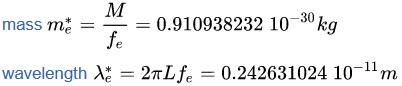
The frequency of the electron is 1023 units of Planck time = feT. The wavelength comprises 1023 units of Planck length = feL. However we have only 1 unit of Planck mass M per fe (1 unit of mass for every 1023 units of time). Let us suppose that the electron is centered on a Planck black hole (this unit of Planck mass). The black-hole electron thesis. For 1023 units of Planck time, this center is obscured by an electric 'cloud' of AL (ampere meters). These AL units then combine with a unit of T and cancel, exposing for 1 unit of Planck time that black hole center.

And so for this 1 unit of time the electron 'has' mass (1 unit of Planck mass). The universe clock ticks and the electric cloud returns. It is this black hole center which gives the electron its point co-ordinates**, the electric state can be considered a wave-state that has no fixed co-ordinates. And so, instead of a physical particle, the electron (as with other particles) is an event that oscillates over time between this magnetic monopole AL electric (wave) state (duration dictated by fe) to a mass (point) state (duration 1 unit of time). Therefore the shorter the particle frequency, the more 'mass-like' the particle properties will appear to have, the longer the frequency, the more 'wave-like'.
This also means that mass is not a constant property of the particle, rather the electron mass that we measure is the frequency of occurrence of these units of Planck mass when averaged over time. We can measure the energy of the electron using the formula E=hf. This h is Planck's constant, and is an energy constant, its value doesnt change, the frequency f term determines how often it occurs (per second), the more often it occurs, the more energy we have.
We can also use E=mc2 and we get the same answer, for some reason hf=mc2. If E=hf measures the frequency of the wave-state, and for every wave-state we have a mass-state (the particle oscillates between the 2 states), and as m refers to mass, then E=mc2 refers to the mass state, and so hf will equal mc2.
The f term measures frequency, but the c term is a constant, and so it is the m term which is the frequency term. In this formula m does not refer to a constant mass, but instead is average mass, it measures the frequency of the mass-state.
Quarks
The charge on the proton is exactly the same magnitude as the charge on the electron, they cancel perfectly, yet the charge on the proton comes from 3 quarks (UUD) and so we might have thought that the electron also gets it charge from quarks.
Curiously, we can solve the electron formula using 3 magnetic monopoles, (AL)*(AL)*(AL). The unit numbers for (AL) = 3 -13 = -10. To continue the quark analogy, our electron would then be DDD = -30 (note: D = -1/3 unit of charge, U = 2/3 unit of charge and time T = -30), the electron as a unit of minus charge (-30);
DDD = (-10 + -10 + -10) = -30
The AL units = -10. A positron (anti-matter electron) has the same charge as a proton, but we don't have a +10 unit number.
However there is 1 more way to solve the electron formula, and that is with AV monopoles (ampere-velocity). The AV has a unit number +20, if we call this our U quark then we can do this
UUD = +20 +20 -10 = +30
Our UUD particle, although otherwise identical to the electron (returns the formula fe), has the same charge as the proton. If protons were formed in the early days (under intense pressure and heat) from positrons, then we would expect the number of protons in the universe to exactly equal the number of electrons. The universe would then be electrically neutral.
If we add a proton UUD and an electron DDD, we get UUDDDD or 2(UDD), the unit numbers 20 -10 -10 = 0, so this entity would be chargeless, similiar to the neutron, which is UDD.
If we combine a U with DDD then 20 -10 -10 -10 = -10 and we get a D, so we can use an electron to swap between U and D quarks. Fun with numbers.
* In standard physics the electron is a subatomic particle ... but it is not clear to physics what a particle is, we find the following definitions;
a particle itself could be a collapsed wave function or a quantum excitation of a field or an irreducible representation of the Poincaré group or a vibrating string or a thing measured in a detector (-wiki).
** In the vision of quantum mechanics (in the formulas physics use), the electron is considered as a point particle with no volume and no size (-google).
*** ChatGPT (AI chatbox):
According to current scientific understanding, the electron is a point-like particle, meaning that it is a very small object that is effectively a point in space and has no size ... While it is possible to imagine such an object in a purely theoretical sense, there is no evidence to suggest that objects without size actually exist in the physical world ... it is possible that the electron could be considered a mathematical particle. This is because, if it is indeed a dimensionless point, then it would have no physical size or shape, and its properties and behavior would be described by mathematical equations rather than physical characteristics.
And so, although the parameters of the electron are well studied, the existence of the actual electron itself cannot be measured, or tested. Science cannot say what the electron itself is, and so it is inferred (by its parameters). For physics, the existence of the electron, like God, is a matter of faith.