... THE MATHEMATICAL ELECTRON ...
a Programmer-God Simulation-Hypothesis model
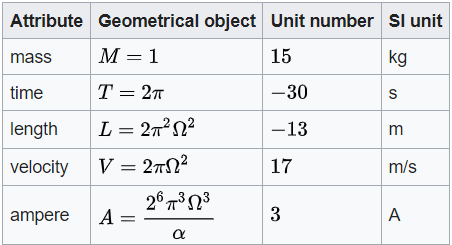
if we assign geometrical objects to mass, space and time at the Planck scale,
and then link them via this unit number relationship,
we can build a physical universe from pure mathematical structures.
Could a Programmer God have used this approach?
Time
There are 3 modes of time.
1) Universe time, the simulation clock-rate. It is a dimensionless incrementing counter, here this variable is labeled age. This foward increment gives us the arrow of time. All particles experience the same age (it is a constant throughout the universe).
initialise parameters
FOR age = 1 TO the-end
conduct certain processes
NEXT age
2) The second. For every increment to the universe clock, a dimensioned object T is generated. This T is analogous to 1 unit of Planck time and so can be measured in seconds. And so the universe clock (that dimensionless incrementing counter age) numerically equates to, but is not the same as, the dimensioned Planck time object T (whose unit is the second). As we are adding 1 Planck time object T per increment to the simulation clock-rate, Planck time is a constant.
initialise parameters
FOR age = 1 TO the-end
create 1 object (time T = π, unit = s)
...
NEXT age
3) Observer time. For the observer, time equates to a change in state, if life was a movie then the incrementing counter age would indicate the number of frames, object time T would represent each physical frame, but we, as actors in this movie, would only be able to detect motion (a change of state). If the Gods pressed the pause button on our movie, our time would stand still, although we could not know this. If for several frames (increments to age) there was no movement (null frames), then we would not register time passing. Only when the frames have different information can we register time. Observer time is relative (see Relativity).