... THE MATHEMATICAL ELECTRON ...
a Programmer-God Simulation-Hypothesis model
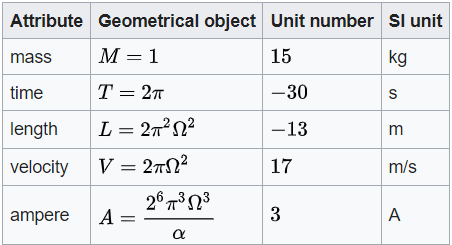
if we assign geometrical objects to mass, space and time at the Planck scale,
and then link them via this unit number relationship,
we can build a physical universe from pure mathematical structures.
Could a Programmer God have used this approach?
The Programming God
As a deep-universe (see 'the Planck scale') simulation hypothesis model is programmed by an external intelligence (the Programmer God), we cannot presume a priori knowledge regarding the simulation source code, other than from this source code the laws of nature emerge (and from which the laws of physics are derived).
Furthermore, although the source code may use mathematical forms we are familiar with (as it would be the origin of these familiar forms), this code would have been developed by a non-human intelligence, and so we may have to develop new mathematical tools to decipher the underlying logic.
For example, the simulation code described here uses a geometrical base-15, the logic behind this is unknown, neither our physics or our mathematics have any corollary.
By implication therefore, the presence of a 'source code' that fits the above criteria could be considered as our first tangible evidence of an external intelligence (external to the universe).
We must also consider that mathematics may simply be a programming language (as with C or Basic or Java ...), and so therefore not an absolute concept in, and of, itself. Although mathematics is the language of physics, and by extension the universe, it may be amiss to assign to mathematics a greater significance.
The Planck Scale
It is posited here that in a deep-universe simulation, the (fundamental) mathematical laws of nature would operate at this Planck scale, and so to understand both the quantum world and the macro world, we must first begin with the Planck world. In the Planck world we find discrete units; Planck mass is the unit of mass, Planck time is the unit of time, Planck length is the unit of length ... proposed are geometrical objects for mass M, time T, length L ... and it is submitted that these are the origins of the Planck units.
And so it is at the Planck scale where we may find the 'hand' of the Programmer.
*Physics has no tools that can investigate much below the quantum world (the testable laws of physics mostly end around the quantum level), and so for science this Planck scale remains a theoretical world.
Planck vs. quantum
It is premised here that the simulation operating system works at the Planck scale, with each increment to the simulation clock-rate adding 1 unit of (Planck) time. This is similar to how we program our digital computers.
initialise parameters
FOR age = 1 TO the-end
{
time = time + 1 (generate 1 time object T)
conduct certain processes
}
NEXT age
In this example, age is the incrementing counter (age = 1, 2 3...), it is also the origin of time (for each increment to age we add 1 dimensioned object T (a unit of Planck time), and so the universe gets older, but the variable age itself is just a dimensionless counter. There is this distinction between the dimensionless variable age (the simulation clock-rate) and dimensioned object T (which we measure using seconds; see Time).
age = 1 is the simulation start (a little big bang)
age = the-end is when the simulation ends
The universe is incrementing in discrete steps; age = 1, 2, 3, .... As particles (and photons) have a frequency, in other words a time component (this means they do not exist at any single unit of time), we could consider them as an (oscillating) event that occurs over time. Time is 1 of the dimensions of particles.
For example, if 1 unit of time (1 increment to age) is a 'frame', then the electron is a 'movie'. It takes about 1023 units of time (increments to age) to make 1 electron (1 frame does not a movie make).

The quantum scale is the scale at which we find our electrons and photons. This also means that we cannot interpret the Planck scale using quantum theories, rather the reverse, we must add a time dimension to Planck scale events to interpret the quantum scale. This is why physics uses probabilities to describe quantum events, if the electron does not exist at any 1 unit of time, then we cannot say where the electron is at any 1 unit of time.
If electrons are events that occur over time (they have a frequency), then we too do not exist at unit time, we too are the sum of many (discrete Planck scale) events averaged over time. I inhabit a human body per second
Gravity is an example (see Gravity), if at the Planck scale there is no solid me or solid planet earth (we are both the observed result of events averaged over time), then there is nothing for a gravity force to act on. Instead, if we replace gravity with particle to particle orbital pairs, which is what atoms do (in Hydrogen an electron orbits a proton), and rotate all these together, and map those rotations over time, we will see satellites orbiting planets and planets orbiting stars. Orbits, like particles, emerge over time. There is no need for a gravitational force as we understand it, and as the orbitals are the same, nor is there a need for an electric force.